

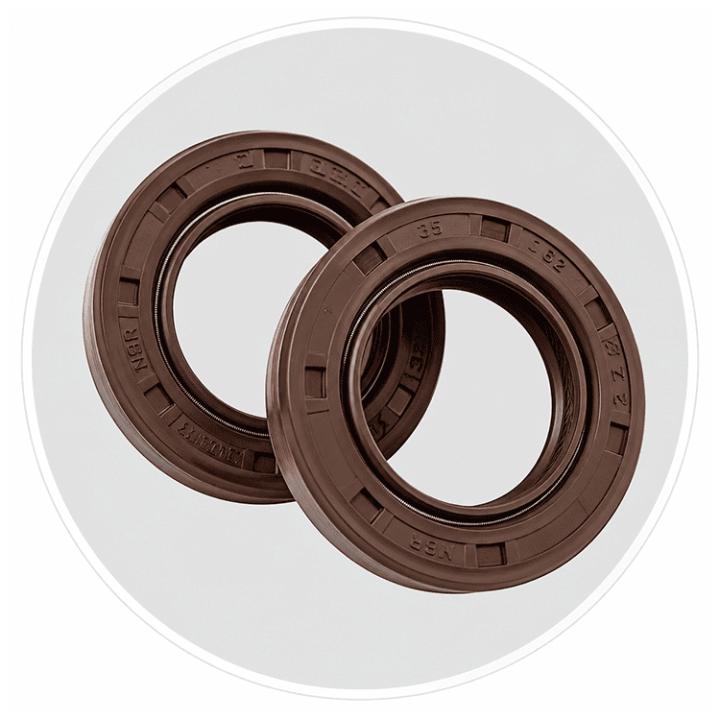
Shift Seal
Shift Seal
categories
Loading...
No products found
Comprehensive Engineering Guide to Industrial Oil Seals (Radial Shaft Seals): Material Selection, Mechanical Configurations, and DIN/ISO Standards
In rotating mechanical assemblies and power transmission systems, Radial Shaft Seals (commonly known as Oil Seals) play a mission-critical role in retaining lubricants (oil and grease) while preventing the ingress of environmental contaminants, moisture, and abrasive particulates into bearing assemblies. Industrial tribology data demonstrates that over 60% of premature bearing failures are directly linked to sealing system degradation. Incorrect elastomer selection, inadequate radial lip load, or exceeding permissible peripheral shaft velocities leads to rapid thermal degradation, lubricant starvation, and catastrophic plant downtime.
This engineering guide from the technical department of Kamyar Gostar Iranian Industrial Co. (DKFL — Manufacturer and Supplier of Heavy-Duty Industrial Bearings and Power Transmission Components) provides an in-depth classification of radial shaft seals based on polymer chemistry, mechanical case design, lip geometry, hydrodynamic pumping features, and severe operating environments.
1. Anatomy and Mechanical Elements of Radial Shaft Seals (DIN 3760 / ISO 6194)
A standard radial shaft seal comprises four primary structural components engineered to maintain dynamic radial load and structural integrity under operational stress:
- Metal Insert / Outer Case: A rigid structural ring made of carbon steel or stainless steel that provides dimensional stability and guarantees a secure press-fit inside the housing bore.
- Primary Sealing Lip: The flexible elastomeric contact edge that maintains dynamic hydrodynamic contact with the rotating shaft to prevent fluid migration.
- Garter Spring: A helical tension spring (carbon or stainless steel) that exerts continuous radial pre-load ($Radial \ Force$) onto the primary lip, compensating for elastomer creep, thermal expansion, and shaft runout.
- Dust / Exclusion Lip (Minor Lip): A secondary non-spring-loaded lip facing the atmospheric side to block dust, scale, and foreign particulates from reaching the primary sealing zone.
2. Elastomer & Polymer Material Classification
Chemical compatibility with base oils and additive packages, continuous bulk operating temperature, and circumferential surface speeds dictate the selection of the sealing polymer:
| Polymer / Elastomer | Operating Temp Range (°C) | Max Surface Speed (m/s) | Chemical Compatibility & Key Advantages | Primary Industrial Applications |
|---|---|---|---|---|
| Nitrile Butadiene Rubber (NBR) | -40 to +100 (+120 peak) | 12 to 15 | High mechanical strength, excellent resistance to mineral oils and greases | Standard gearboxes, electric motors, centrifugal pumps |
| Polyacrylate Rubber (ACM) | -25 to +150 | 20 to 25 | Superior resistance to sulfur-bearing Extreme Pressure (EP) gear oils | Heavy commercial vehicle differentials, automotive transmissions |
| Fluoroelastomer (FKM / Viton®) | -20 to +200 | 30 to 35 | Outstanding thermal stability; impervious to synthetic lubricants, acids, and fuels | Petrochemical plants, steel rolling mills, high-temperature drives |
| Silicone Rubber (VMQ) | -60 to +200 | 15 to 20 | Extreme cryogenic flexibility, ozone/UV resistance; low tear resistance | Food & pharmaceutical processing, cryogenic equipment |
| Polytetrafluoroethylene (PTFE) | -80 to +260 | 35 to 45 | Ultra-low friction coefficient, dry-running capability, universal chemical inertness | Rotary screw compressors, high-speed spindles, aggressive chemical pumps |
3. Mechanical Case Configurations (DIN 3760 Classifications)
Based on the external diameter construction and seating requirements in the housing bore, oil seals are categorized into standard structural types:
Type A / SC (Rubber Covered Outer Diameter)
The metallic insert is entirely encapsulated in vulcanized rubber. This design accommodates higher housing bore surface roughness, compensates for significant thermal expansion in aluminum housings, seals low-viscosity media, and eliminates fretting corrosion within the housing seat.
Type B / SB (Exposed Metal Outer Diameter)
Featuring a precision-machined, ground metal OD, this type provides an extremely rigid and secure press-fit inside cast iron and steel housings. It offers superior dimensional stability in applications subject to radial vibrations and high operating pressures.
Type C / SA (Reinforced Double Metal Case)
Constructed with dual nested steel cases, this profile delivers maximum structural rigidity. It is specifically engineered for severe heavy-duty duty cycles, mining pulverizers, steel mill roll necks, and large shaft diameters (>150 mm) where installation distortion must be prevented.
4. Lip Design and Dynamic Hydrodynamic Features
The geometry and number of sealing lips define the degree of environmental exclusion and internal fluid retention:
- Single Lip with Spring (Type SC / SB): Consists solely of the primary spring-loaded lip for fluid retention. Best suited for clean operating environments free from atmospheric dust.
- Double Lip with Dust Wiper (Type TC / TB): Incorporates a secondary outward-facing auxiliary lip to exclude contaminants. This is the industrial standard across general machinery and gearboxes.
- High-Pressure Profile (BABSL): Engineered with a shortened, reinforced lip hinge and integrated metal backing ring capable of sustaining hydraulic pressures up to $10 - 15 \text{ bar}$ in hydraulic pumps and motors without lip inversion.
- Hydrodynamic Pumping Ribs (Helix Ribs): Features micro-molded directional or bi-directional angular grooves on the air side of the lip that actively pump escaping lubricant back into the oil sump via hydrodynamic action during shaft rotation.
5. Cassette & Taconite Heavy-Duty Sealing Systems for Mining
In extreme industrial environments such as iron ore processing plants, cement clinker mills, and heavy earthmoving equipment, standard lip seals experience rapid abrasive failure. Specialized multi-barrier solutions are required:
Cassette Seals
A cassette seal is a completely self-contained, unitized multi-lip unit that houses its own precision-ground running surface. The sealing lips run against the integrated internal sleeve rather than the shaft itself. This eliminates the need for expensive shaft hardening and post-machining while completely isolating the assembly from slurry and quartz dust.
Taconite Heavy-Duty Sealing Assemblies
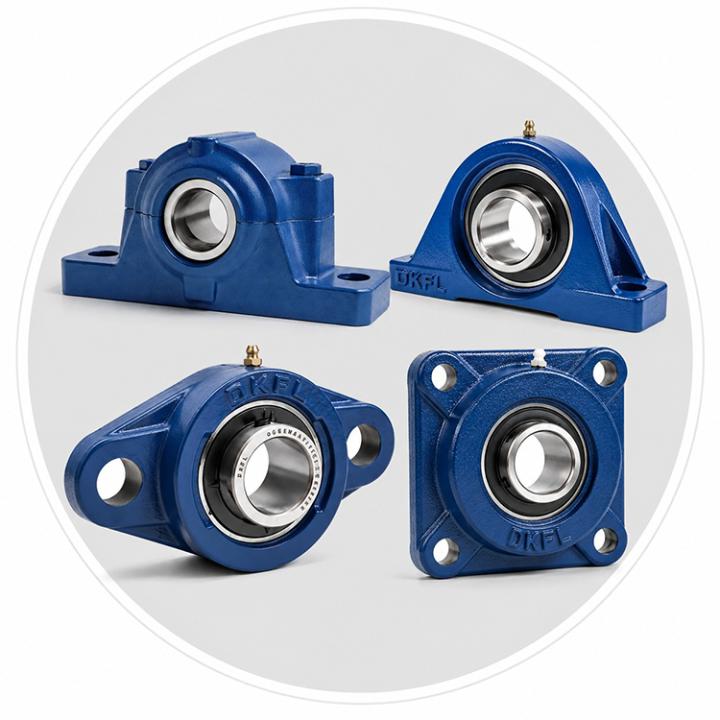
This multi-stage barrier comprises stationary O-rings, a dynamic grease-purged labyrinth cartridge, and an internal contacting V-ring seal. Widely deployed on DKFL split plummer blocks (SNL and SNG series), Taconite seals provide absolute exclusion against highly abrasive magnetite and silica dust in mineral beneficiation plants.
6. Shaft Counterface Requirements and Engineering Installation Best Practices
- Shaft Surface Hardness: The shaft counterface contact zone must be induction hardened to a minimum of $45 \text{ HRC}$ (and $55 - 60 \text{ HRC}$ in particulate-laden environments) to prevent dynamic groove wear.
- Surface Roughness & Texture: Surface finish must be strictly held within $Ra = 0.2 - 0.5 \ \mu\text{m}$ ($Rz = 1.0 - 3.0 \ \mu\text{m}$) using plunge grinding (lead-free machining). Spiral grinding marks act as microscopic screw pumps that force oil past the sealing lip.
- Shaft Entry Chamfer: To prevent lip inversion, tearing, or spring displacement during assembly, shafts must feature a smooth, burr-free entry lead-in chamfer of 15° to 30° with rounded blend radii.
- Pre-Lubrication: Before installation, the cavity between the primary lip and dust lip should be filled to 50% capacity with a clean, compatible lubricating grease to prevent immediate friction scorching during initial start-up (Dry Run).
7. Engineering Frequently Asked Questions (FAQ)
1. What is the technical difference between NBR and Viton (FKM) seals?
NBR is a standard cost-effective polymer suitable for operating temperatures up to 100°C in standard mineral oils. Fluoroelastomer (FKM / Viton®) withstands continuous temperatures up to 200°C, supports significantly higher peripheral surface speeds, and offers chemical inertness against aggressive synthetic ester base oils, bio-lubricants, and extreme-pressure additives.
2. What causes severe groove wear (shaft grooving) under the sealing lip?
Shaft grooving is caused by insufficient shaft surface hardness (below 45 HRC), the accumulation of fine abrasive dust embedded directly into the elastomer contact edge (turning the lip into a grinding lap), or localized thermal degradation of lubricant resulting in hard carbon abrasive deposits.
3. When is it mandatory to specify PTFE lip seals over elastomeric designs?
PTFE seals are mandatory when surface speeds exceed 30–35 m/s, during unlubricated boundary running phases, when temperatures exceed 200°C, or in highly aggressive chemical environments where conventional elastomers experience swelling, hardening, or chemical degradation.