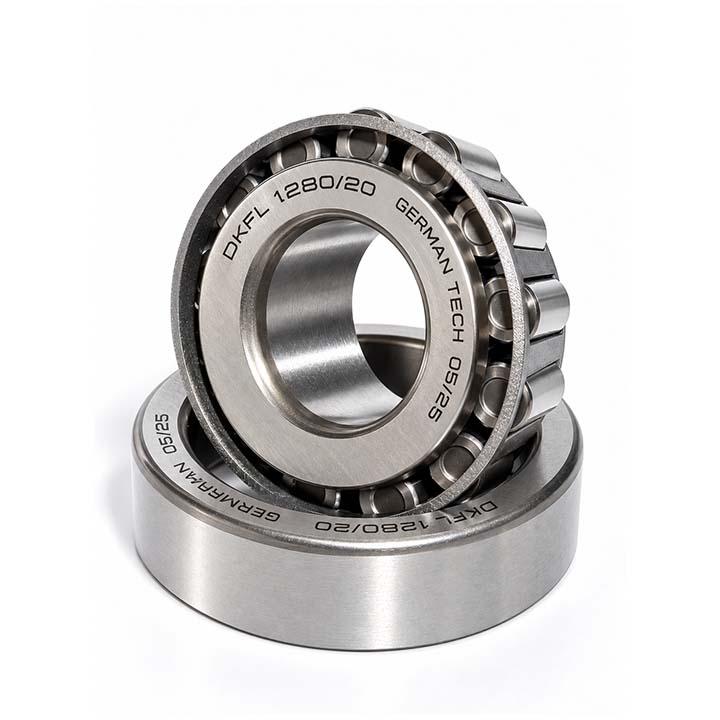
DKFL 1280/20 Tapered Roller Bearing
In real-world machinery, rotating components rarely enjoy an easy ride. Picture the wheel hub of heavy equipment or an industrial gearbox: the bearing does not merely hold the weight of the machine—it also absorbs severe sideways (axial) forces whenever steering, braking, vibrating, or shifting occurs. Under such combined stresses, conventional ball bearings can quickly pit, deform, or fail prematurely.
10060100533
Request a quote
Product Detail
DKFL 1280/20 Tapered Roller Bearing
Outstanding Stability Under Heavy Loads & Continuous Industrial Operations
1. The Story of DKFL 1280/20: When Forces Hit from Multiple Directions!
In real-world machinery, rotating components rarely enjoy an easy ride. Picture the wheel hub of heavy equipment or an industrial gearbox: the bearing does not merely hold the weight of the machine—it also absorbs severe sideways (axial) forces whenever steering, braking, vibrating, or shifting occurs. Under such combined stresses, conventional ball bearings can quickly pit, deform, or fail prematurely.
This is where the DKFL 1280/20 Tapered Roller Bearing comes into play. Instead of spherical balls, it utilizes precision-ground tapered rollers arranged at an engineered angle. This tapered contact geometry acts like a reinforced shield, effectively distributing heavy downward weight and lateral thrust across a broader contact area without compromising rotation speed. DKFL provides an engineered, highly economical solution designed to keep demanding drivelines running smoothly.
📐 Practical Technical Specifications
| Specification | Technical Field | Practical Explanation |
|---|---|---|
| Product Type | Category | Single-Row Tapered Roller Bearing |
| Part Number | Designation | 1280/20 (Industry Standard Series) |
| Manufacturer | Brand | DKFL Bearings |
| Rolling Elements | Element Type | Precision Tapered Rollers |
| Separability | Separable Design | Yes (Outer Cup and Inner Cone Assembly Separate) |
| Load Handling | Load Capacity | Simultaneous High Radial (Weight) & Axial (Side) Loads |
| Core Material | Material Quality | Case-Hardened Premium Chrome Alloy Steel |
| Lubrication | Maintenance | Grease or Oil Lubrication Required Prior to Service |
⚙️ Key Advantages of the DKFL 1280/20 Tapered Bearing
🔹 1. Superior Combined Load Handling
The primary mechanical advantage of the 1280/20 is eliminating the need for separate thrust and radial bearings. Its specialized raceway and roller angles channel complex multi-directional force vectors into an even, balanced load distribution, preventing raceway spalling and unwanted friction hotspots.
🔹 2. Separable Cup and Cone for Easy Maintenance
The bearing consists of two main parts: the outer ring (Cup) and the inner ring assembly with cage and rollers (Cone). Because they detach completely, technicians can press-fit the cup into the housing and mount the cone onto the shaft independently, significantly speeding up overhauls and minimizing installation damage.
🔹 3. Micro-Finished Raceway Surfaces (Lower Running Temperatures)
DKFL applies precision finishing processes to both rollers and raceways. Reduced micro-roughness means minimal rolling resistance, keeping operating temperatures low, prolonging grease breakdown intervals, and maintaining machine efficiency under prolonged running cycles.
🔹 4. Robust Metallurgy & High Cost-Performance Ratio
Engineered from hardened bearing-grade steel, the 1280/20 provides excellent resistance against fatigue, shock impacts, and surface wear. DKFL bridges the gap between top-tier manufacturing standards and reasonable operating budgets, keeping your downtime low and maintenance costs predictable.
📊 Mounting Arrangements for 1280/20 Bearing Pairs
| Arrangement Type | Contact Line Alignment | Moment Rigidity & Tilting Resistance | Preload / Clearance Adjustment | Typical Application |
|---|---|---|---|---|
| Back-to-Back (DB) | Diverging outward | Highest rigidity against tilting moments | Direct adjustment via shaft locknut | Wheel hubs, high-stability spindles |
| Face-to-Face (DF) | Converging inward | Moderate (allows minor shaft deflection) | Adjusted via housing shims or end covers | Industrial gearboxes, drive shafts |
| Tandem (DT) | Parallel in the same direction | High unidirectional axial capacity only | Requires matched precision spacers | Heavy single-direction thrust setups |
🛠 Golden Rules for Installation, Clearance Setting & Maintenance
1. Always Mount in Opposing Pairs with Correct End-Play
A single tapered roller bearing accommodates thrust in one direction only. Consequently, they are almost universally mounted in pairs. Accurate end-play adjustment during installation is vital: excessive preloading creates severe friction and overheating, while excessive clearance causes roller skidding and rattling.
2. Absolute Cleanliness is Paramount
Because of their open, separable nature, keep the DKFL 1280/20 in its protective wrapping until the exact moment of installation. A single trapped particle of grit or dirt behaves like an abrasive paste between the tapered rollers and raceways, shortening bearing life considerably.
3. Complete Grease Packing & Lubrication
Ensure the grease is thoroughly packed between the rollers, rib guide, and cage pockets—not merely wiped across the exterior. Use a high-load, high-temperature extreme pressure (EP) lithium-complex grease, taking care not to overfill the housing void to prevent thermal buildup.
🏭 Practical Industrial Applications
🚜 Commercial Wheel Hubs & Axles
Handling substantial vehicle weight and harsh side-thrust during turns, rough terrain, and rapid deceleration.
⚙️ Industrial Gearboxes & Reducers
Mounted on input and output pinions where helical or bevel gearing generates significant lateral thrust.
🏗 Mining & Construction Equipment
Providing robust reliability in crushing units, vibrating screens, and track rollers exposed to heavy shock loads.
🌾 Heavy Agricultural Machinery
Ensuring uninterrupted performance in harvesters, seeders, and disc harrows under grueling soil and dust conditions.
❓ Frequently Asked Questions
1) What is the main difference between the 1280/20 tapered roller bearing and a standard deep groove ball bearing?
Answer: Standard ball bearings employ spherical balls suited primarily for pure radial loads at higher speeds. The 1280/20 uses angled tapered rollers, delivering vastly greater contact surface area to support heavy combined radial and axial thrust loads simultaneously without structural fatigue.
2) How can technicians identify that a 1280/20 bearing is approaching failure?
Answer: Common warning signs include an audible grinding or rumbling noise during rotation, unusual casing heat buildup, increased shaft play, or visible metallic shimmer in the lubricating grease.
3) Why choose DKFL brand bearings for this series?
Answer: DKFL maintains rigorous heat-treatment and metallurgical standards, delivering tight dimensional tolerances and durable wear resistance at a highly competitive total cost of ownership compared to legacy Western brands.
Order & Request Pricing for DKFL 1280/20 Bearings
Direct supply, certified authenticity, engineering support, and swift international delivery by KGICO Group.