

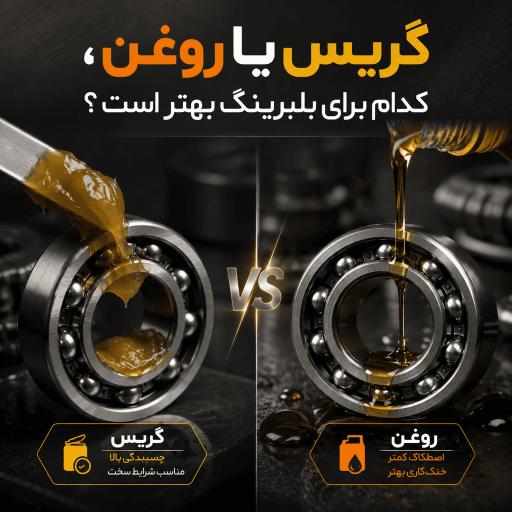
Grease vs Oil Lubrication: Which Is Best for Your Bearings?
Grease or Oil? Which Lubricant is Better for Your Bearing?
In mechanical engineering, no topic influences the lifespan of a bearing as much as the choice of lubricant. Lubricant acts as the lifeblood of your machine. However, when it comes to choosing between Grease and Oil, heated debates often arise among technical engineers.
Is grease always the better option? Or should we opt for oil in complex systems? In this specialized article from the DKFL blog, we take a deep dive into the differences, pros, and cons of these two lubricants.
Grease Lubrication: Simplicity and Protection
Grease is essentially a combination of base oil and a thickener. Due to its semi-solid nature, grease is the primary choice for most industrial bearings (over 80% of applications).
Advantages of using grease:
- Retention: Unlike oil, grease does not leak and remains in place.
- Sealing Capability: Grease acts as a physical barrier, preventing dust, moisture, and contamination from entering the bearing.
- Low Maintenance Cost: Grease systems do not require complex equipment (such as oil pumps and piping).
Oil Lubrication: Cooling Power
Oil reigns supreme in applications where grease fails. Oil can dissipate heat from the friction point and transfer it to a heat exchanger.
Advantages of using oil:
- Excellent Cooling: At very high speeds, grease can cause the bearing to overheat, but oil controls the temperature by circulating through the system.
- Particle Flushing: Oil can wash away small metal particles or contaminants and carry them to a filter.
- Suitable for High Rotational Speeds: When the DN parameter (bore diameter × speed) is very high, oil is the only safe option.
Quick Decision Matrix
| Factor | Grease | Oil |
|---|---|---|
| Rotational Speed | Low to Medium | Very High |
| Temp Control | Limited | Excellent |
| Leakage | Very Low | High (Requires strong sealing) |
| Maintenance Ease | Easy | Difficult |
| Contaminated Env. | Excellent | Poor |
The DKFL Advantage: Quality in the Details
Even the best bearings are doomed to fail if poor-quality lubricant is used. Many premature bearing failures are due to grease oxidation or the separation of base oil from the thickener.
The DKFL brand, supplied in Iran under the supervision and exclusive sourcing of Kamyar Gostar Iranian Manufacturing Industries, has completely eliminated this concern for its customers. In our bearing manufacturing and assembly processes, we use the best and highest quality industrial greases on the global market. The greases utilized in DKFL products feature high boiling points, excellent Extreme Pressure (EP) resistance, and high stability against oxidation.
When you purchase a DKFL bearing, you no longer need to worry about the initial quality of the lubricant; we have implemented strict standards for the initial lubrication of our products to bring the highest efficiency to your machinery.
The Anatomy of a Good Grease; What Makes a Lubricant
an Ideal Choice for Bearings?
When we talk about bearing grease, we shouldn't just imagine a thick, oily substance. Grease is an engineered formulation composed of three main components: Base Oil, Thickener, and Functional Additives. The true quality of the grease is determined by these three parts, and if any of them are weak, even the best bearings will suffer from wear, increased temperature, and reduced service life.
The first and most important part is the Base Oil. The base oil is the substance responsible for the primary lubrication duty; it creates a thin film between metal surfaces to minimize direct metal-to-metal contact. The higher the quality of the base oil, the better the stability of the lubricant film, and the grease will perform more consistently at different temperatures. In industrial applications, the base oil must have good resistance against oxidation, evaporation, and viscosity changes. If the base oil is weak, the grease dries out quickly, loses its lubricating properties, and eventually leads to abnormal noise and bearing failure.
The second key component is the Thickener. The thickener can be considered the skeleton or structural support of the grease—the material that holds the base oil and gives the grease its semi-solid state. Common industrial thickeners include Lithium, Lithium Complex, Calcium, and Polyurea soaps. Choosing the right thickener is crucial because each behaves differently under temperature, moisture, and mechanical pressure. For example, lithium-based greases usually provide a good balance between price, stability, and general application, while lithium complex or polyurea greases are more suitable for harsher conditions and higher temperatures.
The third component, Additives, is what transforms ordinary grease into premium industrial grease. Additives can enhance anti-rust properties, anti-wear characteristics, extreme pressure (EP) tolerance, oxidation resistance, and thermal stability. In bearings subject to heavy loads or mechanical shocks, these additives play a vital role. In fact, if the grease lacks proper additives, the lubricant film collapses under high pressure, leading to metal-to-metal contact—an event that leads to temperature rise, ball discoloration, noise production, and ultimately, premature failure.
The Role of NLGI Grade in Choosing the Right Grease
One of the most important concepts in choosing grease is the NLGI Grade. This grade specifies the stiffness or softness of the grease, not its lubricating power. NLGI grades range from 00 to 6, and the higher the number, the stiffer the grease. For most industrial bearings, NLGI 2 greases are the most common choice, as they offer a good balance between stability, pumpability, and performance.
If the grease is too soft, it may leak out of the bearing housing; if it is too stiff, it becomes difficult to distribute, and at high speeds, it will cause increased mechanical resistance. Therefore, the NLGI choice should be made based on rotation speed, operating temperature, and the bearing's sealing type.
Base Oil Viscosity; The Hidden Yet Decisive Factor
Base oil viscosity is also one of the most critical parameters. Viscosity indicates how thick or thin the oil is, which directly impacts the thickness of the lubricant film. If viscosity is too low, the oil film fails under high pressure. If it is too high, internal friction increases, generating heat. For this reason, when designing grease for bearings, the viscosity must be selected based on speed and operating temperature.
For example, bearings running at high speeds usually need grease with appropriate viscosity and low friction, whereas bearings under heavy load or high temperature require a base oil with greater stability. This is the point where lubricant engineering transforms from a simple choice into a specialized decision.
What Features Should a Good Grease Have?
- High Thermal Stability to prevent degradation at high temperatures.
- Oxidation Resistance to increase the grease's service life.
- Proper Adhesion to remain at the contact point.
- High Load Capacity (EP) for heavy-duty conditions.
- Compatibility with the bearing seals and internal materials.
- Resistance to Base Oil Separation over time.
Ultimately, it must be said that choosing the right grease is not just a purchasing decision; it is part of a preventive maintenance strategy. Good grease can multiply a bearing's lifespan, reduce repair costs, and prevent sudden production line shutdowns. This is why reputable industrial brands use precise and controlled formulations during assembly and initial lubrication so the end product can function reliably in the toughest conditions.
The Dangers of Mixing Greases; Why You Shouldn't Mix
Any Grease with Another?
One common mistake in bearing maintenance is assuming all greases are similar and can be mixed without concern. In practice, this can be one of the most destructive decisions for a lubrication system. Every grease is made of a specific combination of base oil, thickener, and additives, and these differences make some greases incompatible. When two incompatible greases are mixed, the internal structure of the grease may change, the softness or stiffness may become uncontrollable, and the lubricating properties may drastically decrease.
The main issue when mixing greases is the incompatibility of the thickeners. For example, lithium grease may not be fully compatible with certain calcium or aluminum greases. In this case, mixing the two can cause excessive softening or, conversely, abnormal hardening. If the grease becomes too soft, it leaks out of the bearing area, leaving the contact surface without lubrication. If it becomes too stiff, the internal components struggle to move, and the temperature rises. Both states ultimately lead to wear, abnormal noise, and premature failure.
Beyond the thickener, the type of base oil also plays a role in grease compatibility. Some greases are made from mineral oil, while others use synthetic oils. If these two types are mixed without verification, the lubrication structure may be disrupted, and the grease's performance at high temperatures or high pressures may decline. This is especially important in heavy industries, electric motors, and bearings running at high speeds.
Practical Consequences of Mixing Incompatible Greases
- Reduced mechanical stability of the grease and destruction of its structure.
- Leakage from the bearing housing due to excessive softening.
- Increased friction and temperature if it hardens abnormally.
- Reduced load capacity and drop in lubricant film thickness.
- Increased oxidation and formation of sticky deposits.
- Premature failure of balls/rollers and rings due to metal-to-metal contact.
In industrial environments, this mistake often occurs when an operator injects new grease without fully purging the old grease. This becomes especially dangerous when the technical specifications of the two greases differ. Therefore, the best practice is to identify the type of the previous grease before re-greasing, and if unsure, to thoroughly clean and purge the housing. Otherwise, even the best grease on the market cannot perform as expected.
How to Prevent Grease Incompatibility?
To prevent this problem, there are a few simple but crucial rules. First, always check the grease datasheet and assess its compatibility with the previous grease. Second, if changing the brand or type of grease, clean the bearing as thoroughly as possible. Third, avoid mixing general greases with specialized greases without technical consultation. This seemingly simple advice can prevent hefty repair costs, production line downtime, and premature bearing replacement.
In conclusion: Mixing greases is not always safe. While nothing immediate may appear to happen, in the long run, this can lead to degraded lubrication quality, increased temperature, and severely reduced bearing life. That is why in professional maintenance, choosing and replacing grease must be done with technical precision and based on standards, not just based on the availability of another product.
The Proper Method for Bearing Greasing; From Lubricant
Selection to Principled Injection
Even the best industrial grease cannot protect a bearing if it is not selected or used correctly. Proper greasing is not limited to injecting a specific amount of lubricant; it is a set of procedures including selection of suitable grease, workspace preparation, equipment cleaning, determining the correct amount, and respecting re-greasing intervals. Any negligence in these stages can lead to grease contamination, operating temperature rise, and reduced bearing lifespan.
1. Identifying Bearing Operating Conditions
Before choosing grease, the actual operating conditions of the bearing must be reviewed. Rotation speed, load, ambient temperature, presence of moisture or dust, seal type, and daily operating hours all influence the required lubricant. Grease that is suitable for a low-speed, heavy-load bearing might cause increased friction and heat in another bearing running at high speed.
- At high speeds, the grease should have low internal friction and mechanical resistance.
- Under heavy loads, mechanical stability and pressure-bearing capacity are more important.
- In humid environments, water and corrosion resistance must be evaluated.
- At high temperatures, using grease with appropriate thermal stability is essential.
- In contaminated environments, proper sealing and grease adhesion are of special importance.
2. Preparation Before Greasing
Before injecting grease, the area around the grease fitting, nozzle, pump, and the outer surface of the housing must be thoroughly cleaned. The entry of even the smallest dust particles, metal shavings, or moisture into the bearing can act as an abrasive, accelerating failure. For better cleaning, use lint-free cloths and suitable cleaning agents, and do not let surface contaminants enter the system while connecting the nozzle.
If the grease type or brand is to be changed, the residue of the previous grease should be purged as much as possible. If complete cleaning is not feasible, at least the compatibility of the new grease with the old lubricant must be verified via the manufacturer's technical info. Injecting new grease over an unknown grease, without compatibility checks, can alter the structure and degrade the performance of both lubricants.
3. Determining the Correct Amount of Grease
One of the most common errors in bearing maintenance is over-greasing. Contrary to popular belief, completely filling the housing does not always lead to better lubrication. Excess grease during rotation creates internal resistance, causing temperature rise, energy consumption, and even seal damage. On the other hand, a lack of grease leads to a thinning lubricant film and direct metal-to-metal contact.
The correct amount should be determined based on bearing dimensions, rotation speed, housing free-space, and manufacturer instructions